

Beethoven: Op. 59 No. 1
Introduction — A Radical Reinvention
First Movement — A Symphonic Opening
Second Movement — The Scherzo That Defies Form
Third Movement — From Sorrow to Radiance
Fourth Movement
The Scherzo That Defies Form
Breaking the Rules
After the massive, heroic first movement we explored in the last video, Beethoven follows it up with one of his most audacious creations yet — a Scherzo that breaks all the rules.
But wait… is it really a Scherzo?
Here, Beethoven crafts a movement that defies classification — a piece that feels as though we’re watching him compose in real time.
It’s unpredictable, inventive, and endlessly surprising — a musical journey you won’t want to miss.
Introduction: What Is a Scherzo?
The second movement of Beethoven’s String Quartet Op. 59 No. 1 is a form-defying one. Beethoven’s tempo marking — Allegretto vivace e sempre scherzando — meaning “Lively, and always in a playful manner” — points to one of his favourite forms: the Scherzo.
The word Scherzo comes from Italian, literally meaning “joke.” Whilst this movement is not necessarily humorous, it abounds with tricks and surprises. The joke here is that Beethoven is playing on our expectations of what a Scherzo should be. To better understand it, let’s take a closer look at what audiences — particularly those at the time — would expect from a Scherzo.
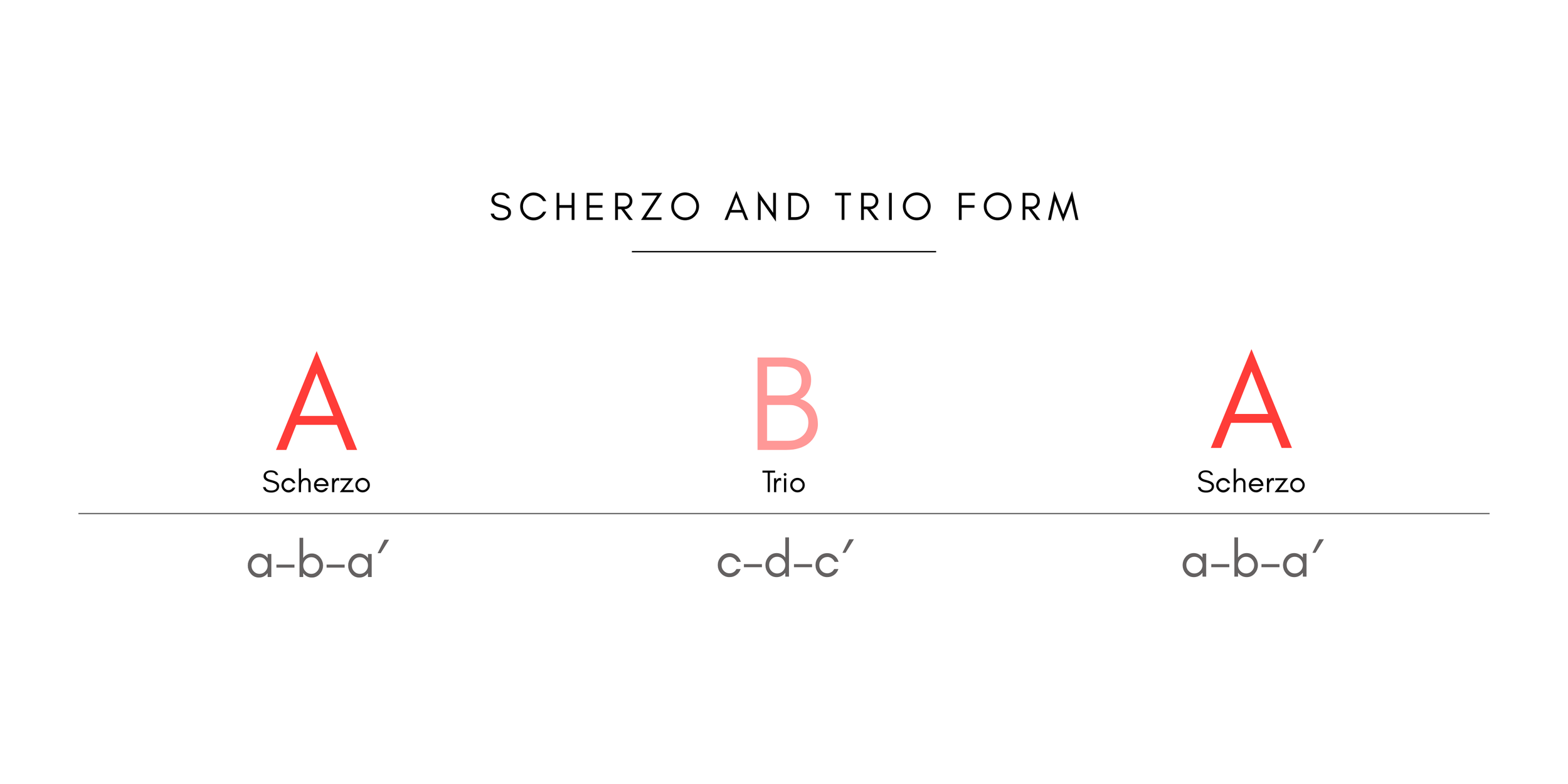
The overall structure of a Scherzo follows what we call Ternary Form — A–B–A. This can be a little confusing, because we often refer to the entire movement as “the Scherzo,” when technically that term applies only to one section. More precisely, the movement is a Scherzo and Trio.
The first A section is the Scherzo itself; the B section is a contrasting one called the Trio; and then we return to the Scherzo again.
Within each of these larger sections, there is usually a smaller structure at work called Rounded Binary Form.
In the Scherzo (capital A), we first hear a main idea — called “a” — followed by a contrasting passage “b”, and then a return of the opening idea, slightly altered — “a prime,” or a′. Internally, the Scherzo therefore looks like this:
a–b–a′
Normally, parts of this repeat, indicated by repeat signs in the score.
The same thing often happens in the Trio (capital B) section: it begins with “c”, moves to a contrasting “d”, and then returns, slightly changed, as “c prime”. The Trio therefore looks like this:
c–d–c′
If we zoom out to the full picture, the movement can be represented like this:
For a textbook example of this form, have a listen to the Scherzo and Trio from String Quartet Op. 33 No. 2 by Joseph Haydn.
In that example, it’s easy to follow the form, because the boundaries between the different sections are so clearly defined. This movement by Beethoven includes many of the formal elements of the Scherzo — but he intentionally blurs the lines between them, so we never quite know where we are in the form. That sense of being slightly lost is part of what makes the movement so fascinating.
However, there are also clear hints of Sonata Form. For example, multiple distinct themes and large, dramatic passages that resemble a Development. In truth, this movement could be — and has been — analysed in many different ways.
Honestly, it doesn’t really fit either form.
Musicologist Joseph Kerman called it sui generis — a unique work that defies classification.
For our purposes, we’ll consider it a hybrid between Scherzo and Sonata forms — though in reality, it’s neither. It belongs in a category all its own.
What’s remarkable about this movement is that it feels as if something completely new is unfolding before us. It’s unpredictable, alive — a work that resists every attempt to pin it down.
No matter how many times we listen, it takes us on a journey of discovery. It’s truly a masterpiece that defies our expectations at every turn.
Now, let’s get into the music.
Scherzo I / Exposition: The Opening Experiment
Scherzo a / Theme A: Built on One Note
Beethoven begins this movement with Theme Group A, and it opens in the most peculiar way: a 15-note rhythmic motif in the cello, played solely on the note B-flat. We’ll call this motif A1.
This opening was so strange that the cellist who premiered the work, Bernhard Romberg, reportedly threw the music to the floor and stomped on it when he first saw it. That might seem like an overreaction today — but it tells us just how completely new and shocking this music was in its time.
Even now, the movement startles us with its novelty and the way it unfolds unpredictably. This A1 motif will become the most important rhythmic thread of the entire movement.
After this bold beginning, each instrument takes a turn responding to the cello’s idea.
First, the second violin answers with a more melodic line — A2.
Then the viola echoes A1, now transposed down to A-flat.
And the first violin replies again with A2.
It’s unusual — almost conversational — to have all four instruments enter one after another like this. But then, they finally come together in unison on the A1 motif, building the first crescendo to forte in the movement.
After this declarative forte statement, Beethoven gives us a brief lyrical idea — we’ll call it A3 — but it never quite blossoms into a full melody. The entire Theme Group A feels fragmented, as though Beethoven is gathering raw ideas and testing possibilities.
Harmonically speaking, the opening of a movement normally serves to confirm the tonality — to anchor us. But here, Beethoven changes key seven times! We’re lost not only in the form, but also in the key — a devilish trick indeed.
Let’s have a listen to the whole of Theme A.
Scherzo b / Theme B: A Flicker of Stability
After this disjunct opening, Beethoven finally settles into D minor and launches into Theme B — the first fully formed melody so far.
This new theme still draws on the rhythms we heard in Theme A. Those same short, insistent rhythms keep reappearing, binding the two sections together.
But soon, the line begins to unravel: the melody slips into off-beat rhythms, and that familiar sense of instability returns.
Scherzo a′ / Closing Theme: Organic Evolution
To close Scherzo I — or the Exposition — the Theme A material returns. At first glance, it seems as though Beethoven is following the familiar Scherzo formula: a–b–a′.
But it’s nowhere near a repeat of the opening. In fact, as we soon discover, Beethoven reshapes it completely. It’s as if all of the melodic and motivic material we’ve heard so far is organically evolving into something else.
This leads to the most explosive moment of the movement so far. A few details stand out here — features that will become hallmarks of the entire movement:
The variety of textures. By juxtaposing passages where a single instrument presents a fragment of melody with moments where all four play independent lines simultaneously, Beethoven creates a rich palette of sound — at once satisfying and, at times, shocking.
Sudden bursts of energy. Sharp dynamic contrasts erupt out of nowhere.
Here, Beethoven also begins to combine the motifs he’s introduced, weaving them together in unexpected ways — a technique he’ll keep developing throughout the movement.
Trio I / Development I: Losing Our Bearings
By this point, we’re completely lost — both in form and in key. Beethoven has blurred every boundary of structure and harmony so far.
And that’s exactly what he intended: to create a feeling of exploration — a sense of not knowing where we’re going.
Wandering and Suspense
Here, Beethoven introduces a new theme in F minor, and we arrive in the contrasting Trio section — or perhaps a Development. But the wandering continues. He moves restlessly through one key after another, keeping us in a constant state of suspension.
The melodic lines pass fluidly among the instruments, forming a tightly woven tapestry of quartet writing. The texture grows denser, the harmonies more unsettled — the music becomes increasingly anxious.
Until finally — as if exhausted by its own searching — all four instruments join in unison, pounding out the initial, abbreviated rhythm. It’s as though they’re crying out: “Make it stop!”
More Searching
After a shocking silence, we move to B major — and for a brief moment, we’re comforted by a lilting melody built from the familiar A1 motif.
But that comfort doesn’t last. The shifting keys quickly knock us off balance, and the sudden outbursts of fortissimo jolt us back into tension.
The music remains restless and searching, never content to stay in one place — until yet another violent eruption returns with that same desperate cry: “Make it stop!”
Scherzo 2 / Recapitulation: A New Key, A New Light
After another startling outburst — and a brief moment of silence — we continue our journey into a second Scherzo, or Recapitulation.
But Beethoven doesn’t simply repeat what we heard at the beginning. Instead, we find ourselves in a completely different tonal world — G-flat major.
It’s unexpected, luminous, and strange.
The familiar one-note motif A1 returns, now paired with a new countermelody (A4) that soon takes on a role of its own. Beethoven begins to weave in melodies we’ve encountered along the way, combining earlier ideas in new and surprising ways — a synthesis of everything the movement has explored so far.
Trio 2 / Development 2: Echoes of the Past
Surprisingly, we now move into a second Trio section — or a second Development. It closely resembles the first Trio, though in a completely different key and much shorter in length.
This passage continues the same spirit of exploration and experimentation that has defined the entire movement. Even here, near the end, Beethoven is still searching — still refusing to settle.
Scherzo 3 / Coda: The Final Build
Finally, we feel as though we’re reaching the end of the movement. This section functions either as a Scherzo da capo or a Coda.
It begins with running sixteenth notes in the cello, which each instrument joins in on successively. This not only echoes the shift from sparse to dense textures that Beethoven has explored throughout, but it also builds a tremendous crescendo, carrying us back to our home key of B-flat major.
Yet Beethoven still has a few surprises up his sleeve. Right up to the end, we never quite know where we’re headed — but what a ride it’s been.
Here, Beethoven further fragments his motifs, passing tiny bits of melody between the instruments. It’s a brilliant play with texture and expectation — each voice picking up a thread, reshaping it, and tossing it to the next.
Even in the final measures, Beethoven keeps us guessing at every turn.
Conclusion: An Unpredictable Roller Coaster
This movement isn’t just Beethoven showing off his structural inventiveness or harmonic daring — he’s taking us on an unpredictable roller coaster of emotion and surprise. He creates a journey where we never quite know what’s coming next. We’re meant to feel lost — and that’s the exciting part.
All we have to do is sit back and enjoy the ride. Each motif, each unexpected turn, feels like a spark of discovery captured in sound.
This is Beethoven at his most playful, most experimental, and most human — reminding us that even when the path isn’t clear, the journey itself can be a thrilling adventure.
This post is part of a larger series on Beethoven’s String Quartet Op. 59 No. 1.
Introduction — A Radical Reinvention
First Movement — A Symphonic Opening
Second Movement — The Scherzo That Defies Form
Third Movement — From Sorrow to Radiance
Fourth Movement