
Chamber Music Circle Paris
presents
Schubert & Dohnányi String Trios
30 May 2026 • 7.30pm • Paris 3rd
Whilst using this digital programme, please silence your phone and use “Do Not Disturb” mode.

This digital programme is also printable for your convenience:


Thank You to our Donors!
As an arts organisation, we depend on generous supporters like you to produce the events that you will experience this evening and more. Your gifts make everything we do possible.
We extend our sincerest thanks to you, our audience, for your generous support.
Tonight’s performance is generously supported by the following people:
Hosting & Reception by:
Simon Todd & See Yeaw Yang

welcome
Thank you for joining us for our 25-26 season finale. Tonight we explore two string trios of two very different young composers.
Schubert composed his third attempt (and only complete) string trio at only the age of 20. Despite his young age, we hear the hallmarks of why his chamber music is so beloved: beautiful melodies, Viennese refinement, charming wit, and even rustic folk music character. This is not one of his chamber works that seeks grandeur, but instead aims to charm and please. And indeed it does. Its simplicity makes it easy to understand and easy to listen to. It invites us into a world of polite company: full of grace, lyricism, and gentle conversation between three instruments.
Dohnányi’s Serenade, written in 1902 when he was only twenty-five, belongs to a very different sound world. It marks an important step towards his more mature style, and shows both his command of form and his delight in wit, surprise, and energy. By calling the work a serenade, Dohnányi looks back to the eighteenth century, but he does not simply imitate the past. Classical forms are used as a starting point, then gently twisted, stretched, and subverted.
Part of the fascination of the piece is the way it brings together so many musical worlds: modal colours that can suggest Renaissance harmony, the charm and humour of Haydn, the sweeping Romanticism of Brahms, and even a more modern play with tonality. In lesser hands, this might feel like a patchwork. But Dohnányi holds it all together with remarkable confidence, creating a work that is constantly varied, full of character, and surprisingly cohesive.
Thank you for your support throughout this season, and please enjoy tonight’s show.
KYLE founder & director
programme
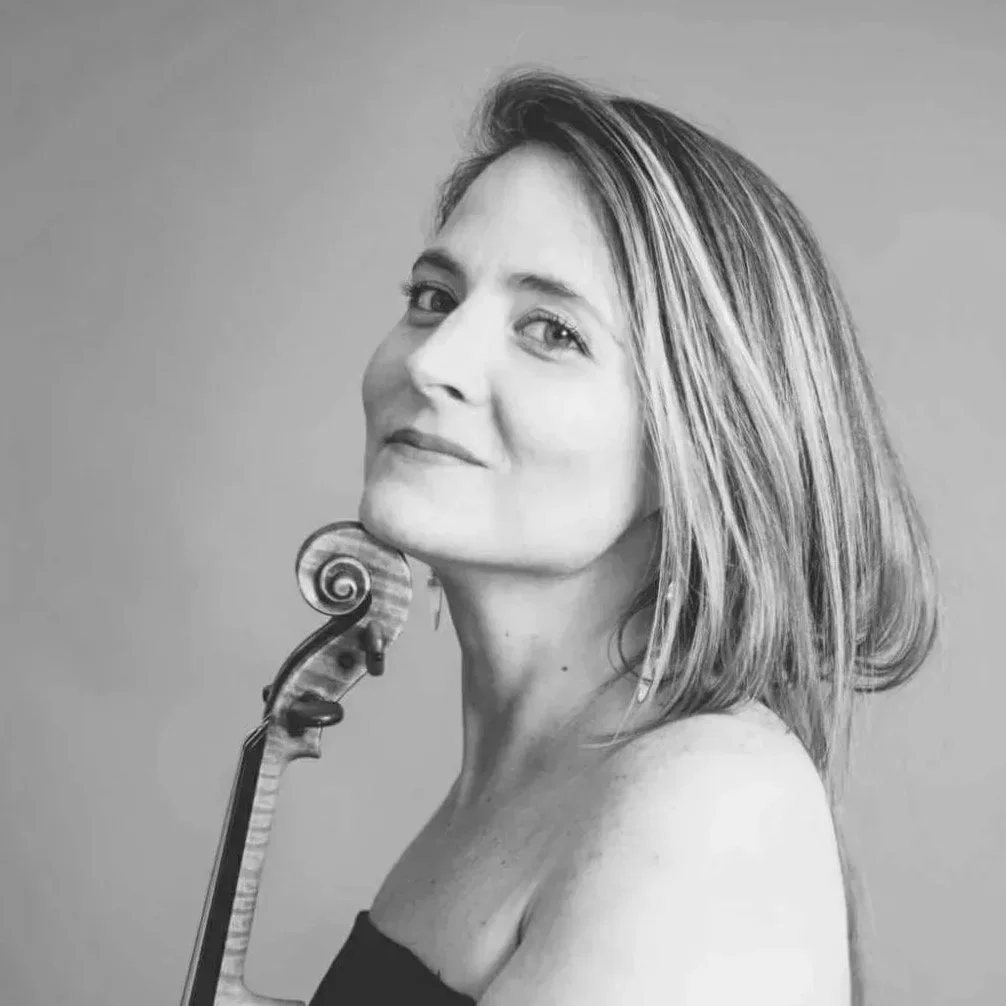
Elissa Cassini violin
Kyle Collins viola
Marie-Thérèse Grisenti cello
Franz Schubert 1797-1828
String Trio in B-flat major, D. 581 (1817)
Allegro moderato
Andante
Minuetto. Allegretto — Trio
Rondo. Allegretto
Interval
10 minutes
Ernö Dohnányi 1877-1960
Serenade in C major, Op. 10 (1902)
Marcia. Allegro
Romanza. Adagio non troppo, quasi andante
Scherzo. Vivace
Tema con variazioni. Andante con moto
Rondo. Allegro vivace
-
Composed: 1904
Duration: about 23 minutesOne of the first works in which Dohnányi felt he had achieved a personal, balanced musical language, putting off these late-Romantic influences, was his Serenade in C major for String Trio, Op 10, composed in 1902 during a concert tour to London and Vienna and premiered in Vienna two years later. In five movements, beginning with a March and including a Romanza, the work is clearly in the nineteenth-century serenade tradition as developed by Brahms and Robert Fuchs. Indeed the example of Brahms, who had actively encouraged the young Dohnányi, is still to be sensed at various points. But the Serenade’s conciseness of form and spareness of means indicate a new sensibility at work. There are also hints of the genuine Hungarian folk music that would soon be explored and collected by his younger colleagues Bartók and Kodály, creating modal inflections in the work’s harmony.
The Hungarian flavour is already apparent in the crisp opening Marcia, whose counter-melody, at once soulful and truculent, has an exotic Magyar character. In fact most of the remaining movements refer to the themes of the March in a more or less sublimated fashion. The following Romanza, with its long, shapely and evocative Hungarian-inflected melody, presented in clean textures and rising to a passionate climax, clearly foreshadows the music of Zoltán Kodály. Dohnányi later arranged this ternary-form movement for string orchestra, but it is in the trio form that we can sense the remarkable textural economy of the middle section, a passionate dialogue between violin and cello accompanied merely by arpeggios on the viola. The heart of the work is the vigorous and closely worked Scherzo, which has aspects of a full sonata form and is notable for its irregular rhythms, rapid figuration and deft fugal treatment of themes which are woven together in the final section.
The fourth movement is a set of five variations on a chorale-like theme (itself a variant of the Magyar melody from the March) which evoke an almost Schubertian lyricism. The Rondo Finale is perhaps the most Brahmsian movement in character. Towards the close the sonorous Magyar melody from the first movement makes an unexpected reappearance in its original form, satisfyingly binding the work together into a structural unity, although the formal brightness of the ending in C major is surely undercut by the tune’s melancholic protest.
CALUM MACDONALD


support us
Help us keep these concerts alive.
If this evening moved you, surprised you, or simply gave you a moment of beauty, we invite you to help us for the next season of this series.
The Chamber Music Circle is sustained by the generosity of its audience. Ticket sales cover only part of the cost of each concert, and your support helps cover the artistic planning, production, organisation, and musician fees behind every evening.
A contribution of any amount helps us to plan the next season and continue to offer intimate chamber music experiences in Paris.
Contributions support the artists and the continuation of this concert series.
coda
Receive news about our upcoming events, special offers, and more.
Share the CMC experience
@ParisCMC #CMCexperience
Special Thanks
A very special thank you to our hosts and longtime supporters, Simon and See Yeaw. Over the years, you have supported the CMC with remarkable generosity, both morally and financially. Quite simply, we could not do what we do without you. Truly, thank you.